Saturday, February 14, 2009

If you're cold, put on a hat!

(Not to contradict Brenda's wise tag line. I've just been a bit hat crazy lately.)

I have a lot of catch-up to do. I'm ashamed of how long ago I finished some of the hats in this post, but let's just say that I've been doing a thorough test-drive of some of them before blogging. You know, just in case...

I'll start out with the hats knit from yarn I bought, and then go on to hats knit from yarn I spun, along with information about the handspun. Thank the Fiber Goddess for Ravelry, which has become my supplemental fiber brain. At least I'm a bit better about putting information in there than I am about blogging in a timely matter, so that something is recorded somewhere when it's time to blog!
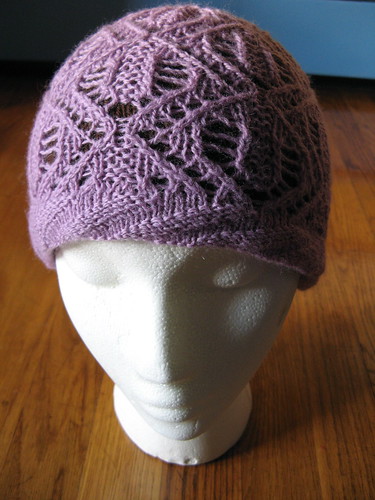
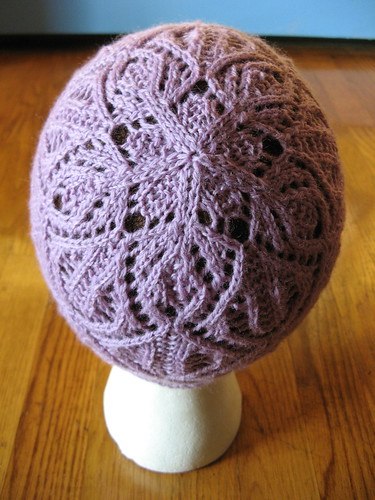

cloche

cloche


This is the Peek-a-Boo Cloche by Mona Schmidt, from the book Lace Style. The original pattern calls for a sportweight yarn (one of the Louet yarns, maybe?), but when I decided to knit this the colors of leftover Knitpicks Palette sitting in the drawer (from the Fair Isle with Vertical Stripes, from oh so long ago) were calling to me. Palette is a fingering weight, and not a very robust fingering weight at that, but I decided to give it a try. The lining of the hat is knit first, from the top down, so I figured that I'd know fairly quickly whether the yarn would work, and if I'd have to alter the pattern for a vastly different gauge. My head is on the small side, so I had a good feeling about the project, and it turned out that it worked just fine, without any size alterations. The hat is just the right size for my small head, but I wouldn't want the hat to be any smaller. (So copy me at your own risk!)
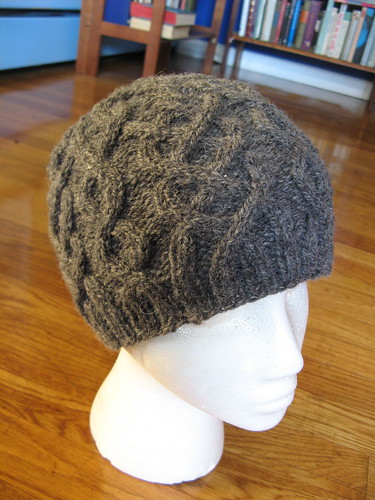
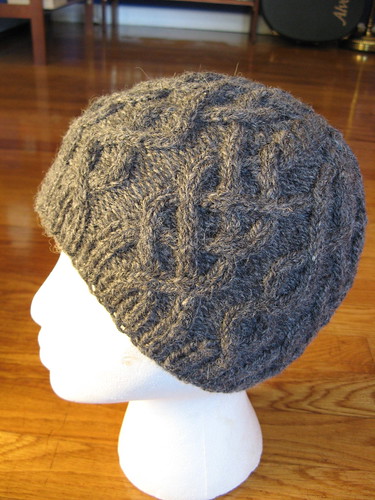


HabitatHabitat


This is Habitat, by Jared Flood. (I always want to say that it was designed by Franklin Habit. Yes, I know all knitting men are not the same person.) I wish I had a better photo of it, but the light was just not cooperating that day, and I haven't had a chance to get a better shot. Which is a shame, because Alex wears it a lot. It was a birthday gift 2 months ago, and I'm delighted with how often he wears it, and how much he seems to like it.

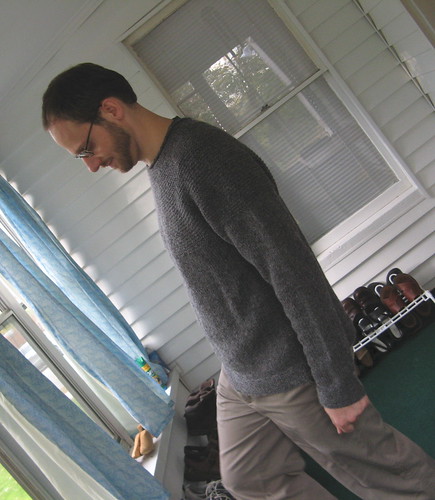
The yarn is Harrisville Highland, leftover from Alex's Cobblestone sweater, which he also wears often enough to make me very happy. Maybe it's lucky yarn, or maybe I'm getting better at knitting things to match his size and taste. (I wear the Rhapsody in Brown sweater more often than he does. It's a bit tight on him, and I can't seem to get a more severe blocking to take. It's a little big on me, but in that just perfect way that makes it incredibly cozy.)


And now onto the handspun. This first hat was quite the bargain. I bought the fiber at New Hampshire Sheep & Wool last May, and only paid $8 for the 4 oz. I believe it's Ashland Bay top, but I didn't realize it at the time. It's not a bad thing, though I feel a bit silly in retrospect, buying such widely available commercially prepped top at a local fiber event. It's 100% merino, and I carded it into rolags before spinning. I found that the fiber was a bit flat at first, and a couple of people suggested that I steam it, to put some life back into it, and re-awaken its merino crimp. That did help, and I was delighted with the soft, fluffy, and lofty yarn that resulted.
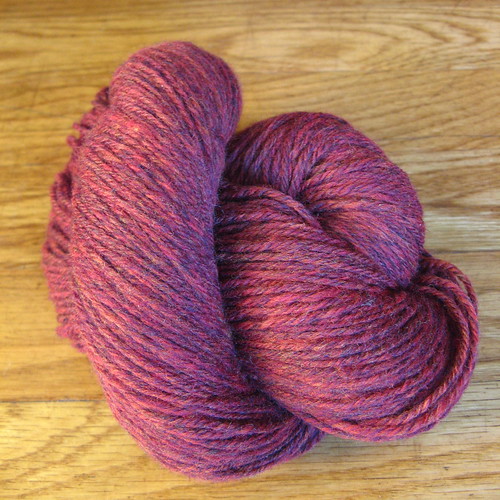
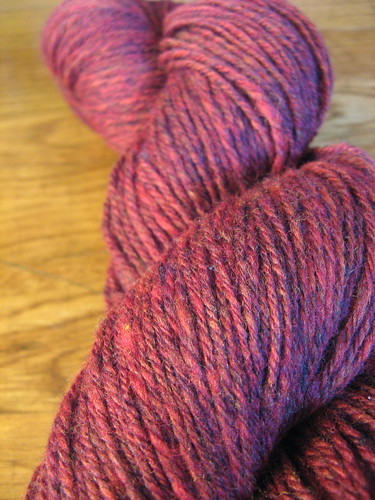
fluffy red merinofluffy red merino


As you can see, and as I think I mentioned in a previous post with yarn spun in a similar way (commercial top carded into rolags), you don't get a perfectly even yarn when you spin longdraw. Especially when it's from rolags, where the fibers are all jumbled together in a chaotic swirl. But I'm learning that knitted fabric can be very forgiving, and that most of the unevenness in yarns like this disappear when you knit them up. It's kind of magical, and only encourages me to spin longdraw more often. I hope seeing hats made from uneven woolen spun yarn gives some of you confidence to try it out, too.

The yarn is a 3 ply DK weight, 13 WPI, 105 grams, and 342 yards.

ShedirShedir


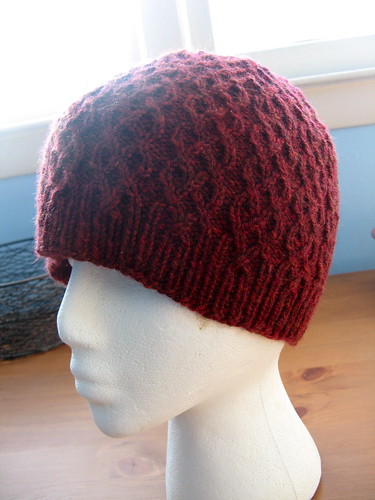
The hat is Shedir, by Jenna Wilson, from the Fall 2004 edition of Knitty. I wasn't sure at first that the yarn would work with this pattern, because such delicate crosses would seem to require the most perfect and even of yarns, to avoid getting lost in the texture of the yarn. But it turns out that slightly uneven handspun works well, too. The cables probably would have popped more if I used a worsted spun yarn, which would be smoother. But I like the subtle and soft look that the woolen yarn gives to the hat. This is my favorite hat, and I honestly can hardly believe that I made it from scratch.


These last two hats are also knit from handspun rolags. These rolags are from washed corriedale locks that I bought from Julie (jsandell on Ravelry) a while ago. Having worked with other corriedale since then, and having discussed the nature of these particular locks with her, I think I've come to the conclusion that this is not typical corriedale. In some ways it behaved more like a longwool would, in that it wasn't as crimpy, and had a very smooth feel to it. In retrospect, it was not the ideal fiber for rolags, since I've found that I prefer rolags and longdraw spinning with very crimpy fibers. But I made it work, and enjoyed the experience.
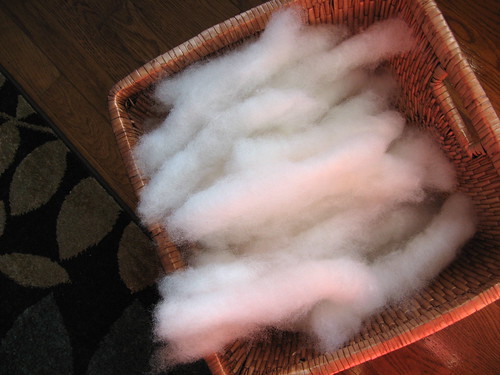
corriedale rolagswhite corriedale


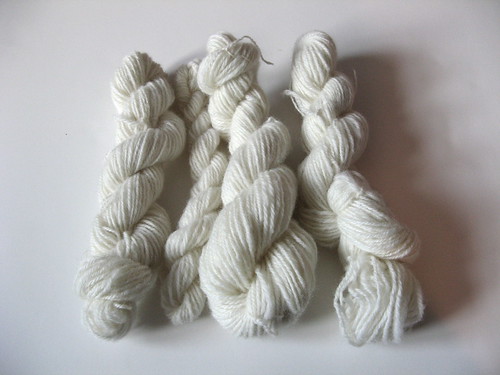
That is about 550 yards of a 3 ply, 9 WPI yarn. It was all spun longdraw from the rolags, and wasn't quite as even as it looked. I don't think it was as even as the merino I spun up for the hat. Next, I dyed it:
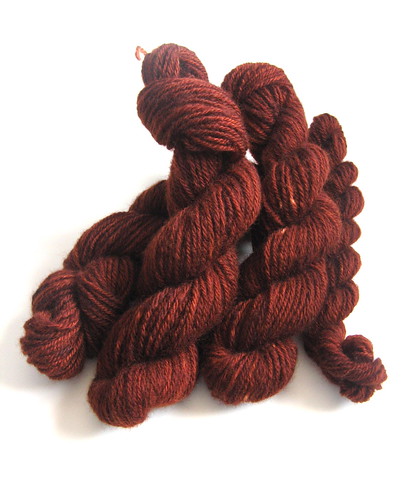
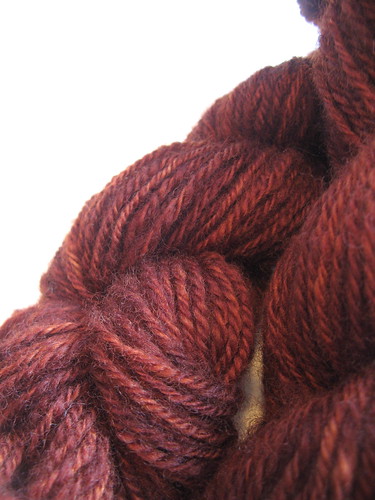
hand carded/spun/dyed corriedalehand carded/spun/dyed corriedale


This was my first (and only, so far) experience dyeing anything, and I was happy with the results. It turned out darker than what I was going for, but I think the yarn was just perfect this way, so it was a happy accident.

I knit two hats with the yarn. The first hat was too big for the intended recipient, and the hat would just not shrink, no matter what I did to it. A very strange corriedale, indeed, as I'd expect most corriedale to full easily if given the opportunity. I think it was the relative lack of crimp in the yarn.
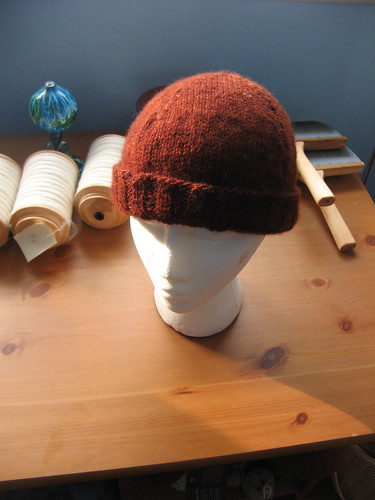
Jan's HatJan's Hat


This too-large hat is from Jared Flood's Turn A Square pattern. It's a beautiful hat (if I may toot my own horn), and I'm sure I'll be able to find someplace to donate it. Heck, I know it won't felt in the wash, so I bet that even charities that don't usually take wool (because of felting fears) could make good use of it!

I decided that my second try at a hat for Jan would not only be on smaller needles with slightly fewer stitches, but would also incorporate more of a ribbing-based pattern, for optimal fit flexibility. I decided on the spindle stitch pattern from Charlene Schurch's book More Sensational Knitted Socks.
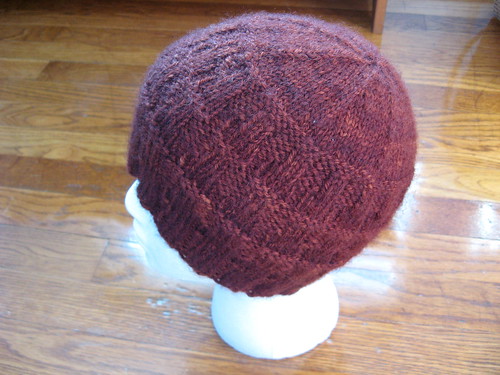
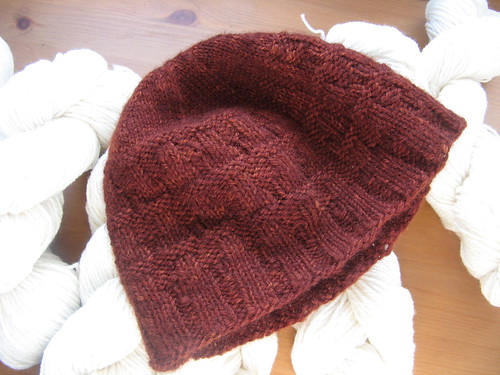
Jan's Hat (for real)Jan's Hat (for real)


The hat fits her perfectly.


I do have one other hat that I've knit in the past few months, but I'm not blogging about that yet. That hat was also knit from fiber that I prepped (on combs) and spun myself, and uses a beautiful Barbara Walker stitch pattern. I did a ton of work designing a way to decrease the top of the hat in an unusual and interesting way that flows out of the intricate stitch pattern, and am probably going to submit the pattern to the Twist collective, for consideration for their Fall issue. Writing up that proposal is on my to-do list for this long weekend. I really wish I could share the photos with you, because I am immensely proud of the hat. This one was also for a co-worker (a Secret Santa gift), and luckily fit her perfectly on the first try. More on that another time, I suppose.


My spinning wheel has been incredibly busy so far this year. I have finished spinning the yarn for a sweater. That's how busy. More on that soon, I hope.


Oh, and in case anyone was wondering, Sophie was born the day after my last post, and is indeed an extraordinary little person. She has beautiful red hair and at least one dimple, and is so incredibly charming in photos that I fear I may be bowled completely over when I get to meet her in person. To my delight, the sweaters are a bit big on her, which means she gets to grow into them and wear them that much longer.

Labels: , ,

Sunday, October 05, 2008

simple gifts

I've been knitting a lot lately, and it feels so nice to have some finished objects to share. I'll keep it to the two that are gifts, and going out in the mail today.


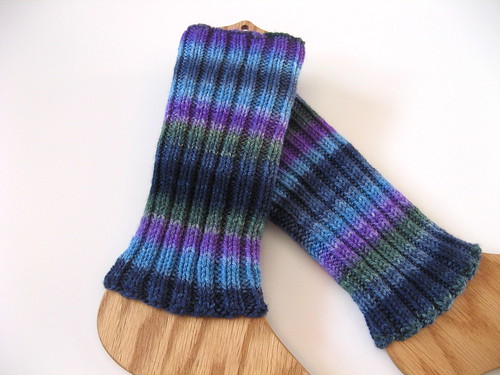
First, there are the legwarmers for a wonderful kid who just turned four, and who needs something stripey and soft and funky to add to her wardrobe. Her mom often lets her choose her own outfits, and her style leans toward eclectic and layered, so I have confidence that these legwarmers will fit right in.

Shoshanna's legwarmers

Shoshanna's legwarmers


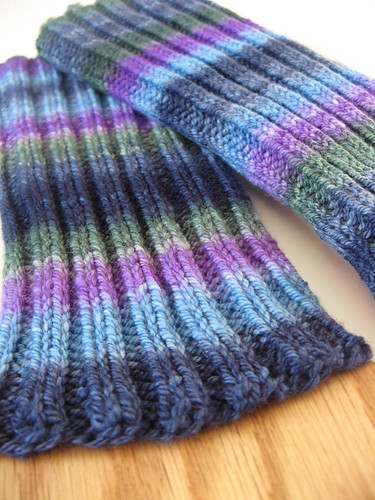
These things are super simple -- cast on, work 2x2 ribbing for a bit, and then bind off. They yarn is my own handspun, from a BMFA Sheep 2 Shoe kit in the lapis colorway. It's a worsted weight yarn, and a superwash merino, so it should be soft on her legs, and easily washable. I spun and plied it fairly tightly, so I think the legwarmers should wear well. And I think I managed to cast on the right number of stitches so that they won't slouch too much now, but enough that they will grow as she does. I can actually stretch these over my legs, though of course they're pretty short on me.

I'm hoping there will be some modeled shot to link to soon, when super four year old receives her somewhat late birthday gift.


My other finished project is actually a commissioned project, as a gift for a friend of my mom.

Shetland Triangle


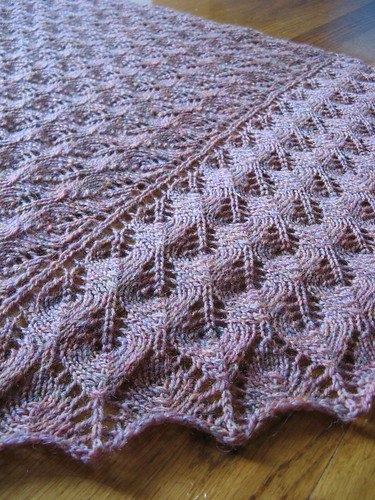
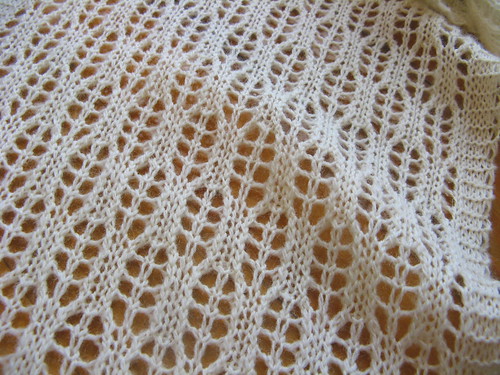
This is the Shetland Triangle, designed by Evelyn Clark, from Wrap Style. I've been eyeing this pattern for a long time, and finally bought the book during the last Interweave Press hurt book sale. It's the only pattern in the book I knew I wanted to make, and the book was discounted to less than the price I'd pay for a copy of just one pattern, so I figured it was definitely a good time to buy!

I used Reynolds Whiskey for this pattern. It seemed like a good match for the pattern, not only because I happened to have some, but because like the pattern it's a yarn I've been wanting to work with for a while. It's a fluffy and light sportweight yarn that comes in deeply heathered colors. I really liked working with it, and am probably going to use what I have leftover for a big EZ Pi Shawl, at some point.

What I really love about the Shetland Triangle is the background. For me, this lace pattern isn't about the holes, but about what the increases and decreases do to the flow of the stockinette background. I think I captured that pretty well in the above photo. I just adore how the stitches gently curve in and out. I think I'm eventually going to have to make one of these for me. If you want a couple more photos, you can find them here and here. The second photo shows the entirety of the shawl -- not a great photo (it's hard to artfully capture such a large thing in one shot), but I'd feel bad about not having a shot that isn't a closeup.


That's about it for now. But I have been doing a lot of fleece washing, and have a lot to talk about at some point. I've learned a ton, and can't wait to share my learning process with you guys. I've also been doing some spinning, including some new to me fibers. I have a gorgeous skein of loosely spun thick Wensleydale singles, and just started on some bombyx silk top this morning. yum. Great things to come!

Labels: , ,

Tuesday, April 22, 2008

The Browns Of Spring

It's quite a shame that we seem to have skipped over mud season in New Hampshire this year, because it would have been the perfect name for my most recent completed yarn.

Zabet's yarn


If I were really clever, I would have thought of that name for it before I sent it to its recipient, so I could have made a fancy Mud Season label for it.

Zabet's yarn


What do pastels have to do with Spring, really? Spring is all about mud and dirt, with little hints of green and vibrant color poking through. This is the perfect Spring yarn. You just didn't know it until now!

I spun the yarn from merino roving I bought from Fibrespace Supplies. She has several collections of merino rovings in color groups. I've already spun up the rainbow roving, and have a collection of rose colored roving that I have fun plans for. This was spun from the forest colors, plied with a chocolate brown. There are 2 skeins, weighing about 180 grams in total, at just under 500 yards, for a 15.5(ish) wpi 2 ply sportweight yarn.

The best thing about spinning yarn for other people? They get to decide what to do with it. No pressure, eh?


I have managed to get a bit of knitting done in addition to all of the spinning. However, I haven't figured out, yet, how to rationalize black and blue as springtime colors. So there goes that theme:

Haida socks for Jules


Those are pretty plain socks, but I expect you to be all impressed at how big they are. I got an unexpectedly large amount of sock out of one skein of lightweight Socks That Rock, so if the pleasure of knitting socks to warm a friend's husband's feet wasn't enough, I now know how much sock I get get from STR. Good information to have! If you're curious, these socks are 64 sts around in 2x2 ribbing, 8 stitches/inch, 11 rows/inch, 6" leg (before heel flap, so 8" total height), 11" foot (an excess of foot, if you ask me -- what do they do with all that flesh?), and about 5 grams of yarn leftover when all was said and done. (And that was with a skein that was at least a few grams short from the beginning.)

I think that photo captures the colors fairly accurately. I was impressed with the colorway, as I've heard that some people had problems with black dye coming off on hands or in soak water with the Raven series. My hands were clean, and my soak water was clear. I'd certainly consider knitting with some of this stuff again.


The mega-socks haven't been my only Blue Moon Fiber Arts project as of late. I'm almost done with a Sheep 2 Shoe kit in the Pink Granite colorway. I have about 15-20 grams (out of 8.5 oz!) left to spin before plying, so I'll have a lot of information on that soon.

pink granite bobbin


What I'll say about it now is how strange it is that I chose this colorway, as I just finished knitting up a Raven colorway, and have started knitting socks in the Rose Quartz colorway. The Pink Granite roving has the black of the Ravens, as well as pinks that are exactly the same as the pinks in the Rose Quartz, making it quite strange to alternate between the knitting as the spinning, since the spinning is nowhere near ready to knit, yet I continuously feel as if I'm already knitting with it! I adore the pinks in the roving and in the Pink Quartz yarn (which I've been looking for an excuse to try for a long time), but one thing I'm learning during this spinning project is that I'll be reluctant to buy a Sheep 2 Shoe kit in a Raven colorway. For some reason, I just don't like spinning the black parts of the roving nearly as much as the rest of it. It feels harder to spin evenly (maybe because of the darkness), and feels dry. But more on that in a week or so (I hope), when I have some finished yarn to show you. I'm so excited to ply, and see what I get!

I've felt kind of uninspired regarding written expression lately, so apologies if this post seems dry or awkwardly worded. I just needed to push through and get something out, lest you (and I) think I fell in a deep, dark mud pit. So look at the pretty pictures and ignore the rest if necessary, okay?

Labels: , ,

Friday, February 29, 2008

Francie

bluebarkbottomcropped


Some people called it the Tree of Heaven. No matter where its seed fell, it made a tree which struggled to reach the sky.
-- Betty Smith, A Tree Grows In Brooklyn


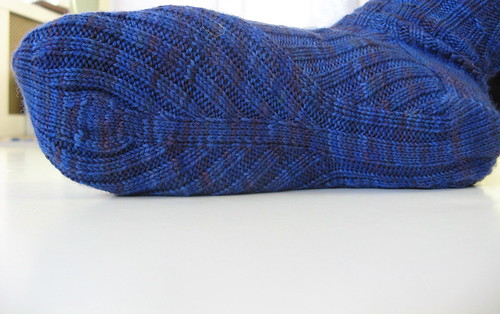
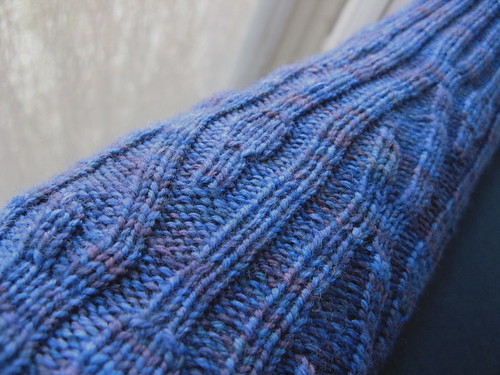
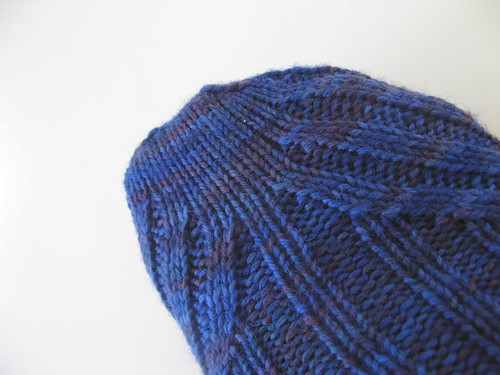
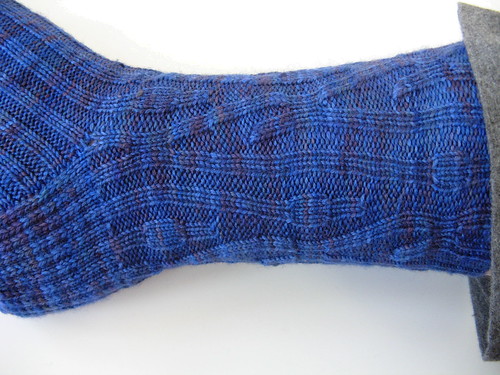
These socks are named for Francie Nolan, the main character in my favorite book, A Tree Grows In Brooklyn. Like the book, and like Francie, the socks are full of unexpected beauty and character. There are stories hidden in their folds, interesting shapes to be found in their bark, and new ideas to be found in their branches.

Smooshy Sock Preview


These socks were designed with an adventurous knitter in mind. While the leg of the socks is easier to execute than it might appear at first glance, the foot of the socks involves shaping that is probably new to most sock knitters. This shaping results in interesting curves in new places, a foot-hugging contour that surpasses the comfortable clinging power of most traditional ribbed socks, and a new way to shape a toe. The socks may take a bit more concentration than you’re used to, particularly once you get to the foot, but once you find the rhythm of these socks everything should fall into place.

Nataliefootcropped
(photo used with the permission of Natalie)


These socks were knit with Dream In Color Smooshy, at 8 stitches per inch, on U.S. size 1 (2.25 mm) DPNs. You can use any sock yarn you like, preferably in a solid or nearly-solid color. This sock is very stretchy, and will fit a wide range of foot sizes. You can easily customize the fit of the leg and foot by changing needle sizes, to make the circumference a bit wider or a bit narrower. Because the entire sock is based on 2x2 ribbing, the sizing range is generously large. There are instructions in the pattern for customizing the length of the leg and foot of the sock.

Because these socks are a bit different than your average socks, those of you who have knit socks before will have an easier time with this pattern. There is no one skill in these socks that is difficult, but they may take more concentration than your average sock pattern until you get into their unique rhythm. Those of you who can read your knitting (see the difference between knit and purl stitches) will have an easier time with this pattern, although I try to give as much instruction as is reasonably possible. I found them really fun to knit, because I was doing things I'd never quite done before, and it was exciting to see how it would all turn out in the end! There is a lot of new stuff in these socks, and if you like new stuff in your knitting, I think you'll really enjoy knitting this pattern.

The Francie pattern is available for sale right now, as a PDF download. I am using Ravelry's new pattern delivery system, which means that pattern delivery is automatic -- no more waiting for me to email you anything! You do not need to be a member of Ravelry to use the system, although if you are, you have the option to add the PDF directly to the library in your notebook, which is very convenient. The cost of this pattern is $6.50, and you can click the button below to purchase it:


Here is a direct link to the Ravelry page for the pattern.
(Please keep in mind that if you use an e-check, the pattern will not be delivered until the check clears. I believe this can take up to 10 days. I do keep an eye on my Paypal account on a daily basis, to make sure that everyone who has paid by e-check gets their patterns as soon as possible after the check clears, because I know that it is difficult to wait!)

Let me know if you have any problems with payment or with receiving your copy of the pattern. And of course, please contact me if you have any difficulties with the pattern. It has been test knitted by the wonderful and talented Natalie, and proof-read and tweaked until my eyes bled, so I hope it is free of errors. If I (or anyone else) find major errors, I will update the PDF and send new copies to those who have already purchased it. I am quite proud of this pattern, and want to make sure that it brings as much joy to others as it has to me.

bluebarktoe


Oh, and the contest winner! I was a bit embarrassed when the very first person to guess figured out the origin of the pattern name. I thought it must have been much too easy, but was relieved when most of the rest of the contest participants didn't have a clue. Congrats to Dove for being the first person to not only enter the contest, but to enter with the correct answer. Boy are you fast! Please send me an email at the email address in the sidebar, and I will send you a copy of the pattern. Thank you to everyone else who entered. Your guesses really entertained me.

bluebarkleg


Oh, and here's the legal mumbo jumbo from the end of the pattern. There has been a lot of discussion on Ravelry lately about this sort of stuff, and I have come to the conclusion that it is best to put this information here, as well as in the PDF. The short story is that use the pattern however you want for personal use. The long story is:

This pattern was created and written by Rebekkah Kerner. It is intended for personal use, meaning that you may make as many pairs of socks from this pattern as you like for yourself, or to give away as gifts. This pattern is not to be distributed, for free or for money, in any format, without the permission of Rebekkah Kerner. Items created from this pattern are not to be sold or used for commercial gain without the permission of Rebekkah Kerner. If you are interested in working out an agreement to distribute this pattern or to sell socks made from this pattern, please contact Rebekkah using the contact information on the title page of the pattern.


Smooshy sock - 3/4 view

Labels: , , , , ,

Saturday, November 03, 2007

Creepy, Crawly, and STICKY

(First off, I must say that I've had the Can Can song stuck in my head since before my last post. And then yesterday, while I was browsing in a bookstore, a jazzy version of the Can Can song came in over the Muzak speakers. Or perhaps I'm just going insane, poisoned by having my recommended yearly allowance of Can Can concentrated into one week. Condensed Can Can! augh! Though it's starting to morph into the Facts of Life theme song, which, while equally horrific, is at least variety...)

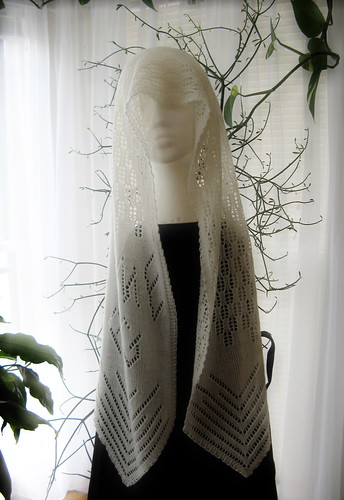
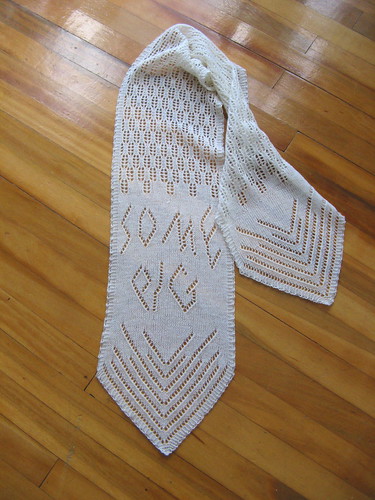
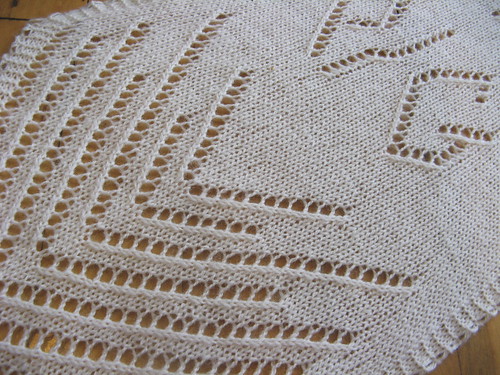
The new issue of The Anticraft has arrived, and among its creepy, crawly, and sticky offerings are my lace scarf. Go to The Anticraft to see the pattern, as well as all the other goodies in this issue. But I'll post some photos here, too:

ACscarf_cello_softglow

ACscarf_wood

ACscarf_buggies

ACscarf_web


This scarf started out as a brainstorm between me and Zabet. Keep in mind that this is only half of a complete package. There were some technical difficulties with the second half of this project, so the concept won't be truly complete for a little while.

Zabet gets credit for the artistic rendering of "Some Pig". She drew it out, and I translated her stylizing of the letters into lace. Erssie asked about the design of the lace in the scarf. I did not use stitch dictionaries for any of it, though it's simple enough that I'm sure the patterning does exist in stitch dictionaries out there. In fact, I was looking through a book (perhaps Victorian Lace Today?) in the bookstore after I finished the scarf, and I saw a shawl that used what looked like the same stitch pattern as the webby ends of the scarf. Then I looked through another book (Folk Shawls, I believe), and learned that I "unvented" the method I used to start the pointy ends of the scarf. The repeating bug pattern in the middle took a while to get just right, involving a lot of graph paper and swatching. It's amazing how easy it is to inadvertently knit a leaf with lace. No wonder there are so many leaf lace patterns out there! It took a while before I got my bugs to be bugs, and not delicate little leaves. (Spiders don't eat leaves, dammit!)

Do make sure to look at the other projects in this issue of The Anticraft. I think this may be my favorite issue, yet. Some of my other favorite projects from this issue are the Pumpkin Pasties (would look delicious if we hadn't just made FOUR pumpkin pies in the last 2 weeks), Black Widow (what I want to bring to the Pumpkin Festival next year), and Spider's Parlor (I want a pet).

So there's one secret project revealed! Please let me know if you have any questions about or problems with the pattern. None of the lacework in it is difficult at all. If you can knit, purl, yarnover, k2tog, and ssk (or left leaning decrease of your choice), you can knit this scarf.

I'm still waiting to hear back from knitty about my other secret project. It should be soon, either way, since I believe the Winter issue is due out in early December. Keep your toes crossed!

Labels: , ,

Tuesday, October 23, 2007

Cobblestoned

cobblestone unmodeled

Cobblestone Modeled


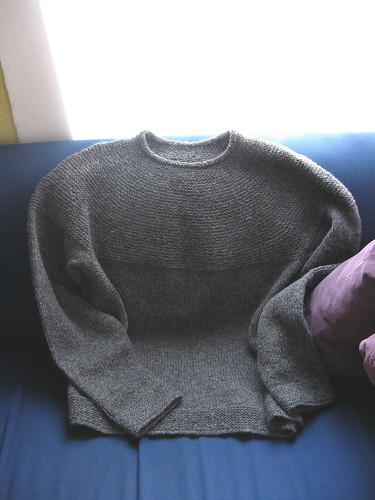
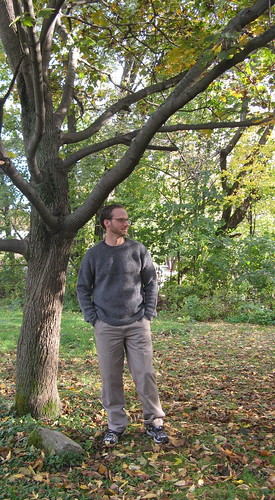
Cobblestone Pullover, designed by Jared Flood, from the Fall '05 Interweave Knits.

I used Harrisville Highland yarn, in the color charcoal, on size 6 and 7 (US) needles. It only took 5.75 skeins, including my swatch! The only major thing I changed was the sleeves. I knit the 2nd size (43.5"), which I think has you cast on for sleeves that are over 11" in circumference at the cuffs. I purposely knit them tighter than that, but even at 10", Alex and I both agreed that they were ridiculously loose. I cast on again, with 10 fewer stitches, for a circumference just over 8", knowing that I could block it a bit wider if necessary. I increased a bit more often than I otherwise would have for the rest of the sleeve, and all turned out well.

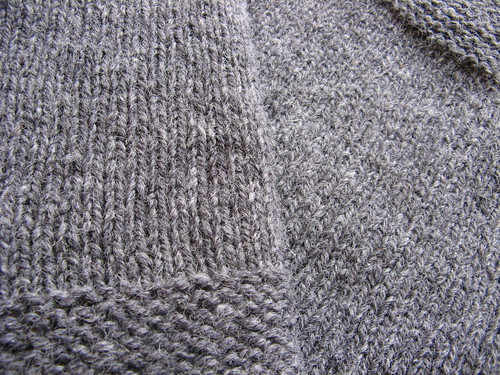
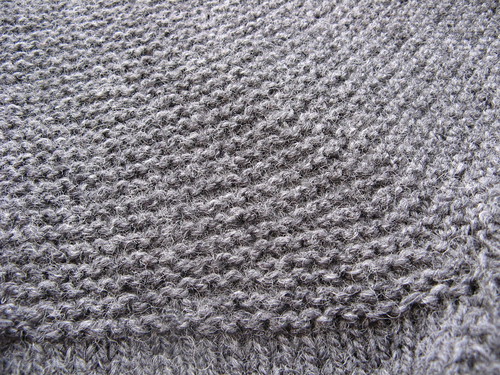
My biggest concern with this sweater was the garter stitch. Garter stitch likes to stretch vertically, and I didn't want the sweater to stretch out of shape -- especially since the garter is at the top, with the weight of the rest of the sweater pulling on it. As I was working the yoke, I tried to measure it while holding the sweater up, so it would be slightly stretched. It was tricky, but I think I made the right choice. Still, if I was going to change one thing about the sweater, I probably would have tightened up the yoke a bit more. Alex declares the sweater perfect, though, so I will leave it alone and be happy.

Some more photos:

Cobblestone Modeled
All those outdoor poses, and one of my favorites is a silly one I snapped while he was taking his shoes off, after the fact.

Cobblestone detail

Cobblestone short rows
short row detail


I'm again in love with this yarn. I put the sweater on to transport it to the basement for its first pre-blocking wash, and didn't want to take it off. It's got that perfect fuzzy, woolly feel to it, and is so warm and substantial. I'm pretty sure I'm going to use it for the next sweater I make for myself.


After the sweater was done, I spent a lot of time spinning. First I finished up the cream colored Shetland singles:

cream Shetland
448 yards!

I couldn't choose which photo to use, so here's another:
cream Shetland on niddy noddy


Here are all four shades together:
Shetland sampler in progress


I've since finished spinning the dark brown singles, too, and am waiting for some red BFL to arrive. So far the plan is a colorwork hat. I think that I'll use the 3 darker colors of the Shetland as the background, with the foreground design in cream. Then I'll line the hat with nice, soft BFL. This, of course, assumes that I will be able to successfully ply these singles and that they'll be about the right weight, and even enough for stranded colorwork that doesn't look like it was knit with my toes or earlobes. And if it all turns out nicely enough, I even know who's getting the hat. (I even chose red for the BFL especially for her.)

I do need to be careful with my spinning. I realized that I tend to lean towards the right when I spin, which was causing soreness in my back and right leg. The solution is to practice standing with my weight evenly distributed, feet shoulder width apart, and all those other things they taught you in middle school gym class that you thought you'd never use. Well, except I'm not doing squat-thrusts while spinning, no matter how humorous that sounds. I also won't have my last name written across my shirt, and will be in no danger of forgetting my locker combination.

Labels: , ,

Tuesday, July 31, 2007

Scroll Lace Sock Pattern

You'll have to scroll down for the Scroll Lace Sock pattern (including those modeled photos some of you have been waiting for). Funny how that worked out. First are some notes on fairs and... unfairs?


This weekend marked the second annual "Drop precious, blood-and-sweat-soaked (figuratively) hand-knitted items off at county fair, cross fingers, and hope that none of them get trampled by goats or covered in award winning jam" Day. I'll find out this coming weekend not only if they survived the goats and jams and other mysterious, sticky county fair dangers, but also if they won me any ribbons. And of course there is the potential monetary windfall. Last year's winnings were enough to buy me one whole issue if Interweave Knits! Oh boy! (I poke fun at the minuscule amount of prize money given out, but in reality, I think they should give no money at all. I have a gut feeling that the prize money may be one of the barriers to getting them to revamp and massively expand the shamefully small number of categories for needlework. I don't need the money; I only need fame and glory and goat-free mittens!)

I submitted, as planned, my Komi Mittens, and decided at the very last minute to submit the Vertical Stripes Fair Isle, since I long ago gave up on the insanity of trying to finish the Autumn Color Cardigan in time for the fair.

Speaking of the Autumn Color Cardigan... no, don't get too excited. I'm not working on it again just quite yet. I have two designing projects to get out of the way first. (And wasn't that a lovely way for me to put it. "Get out of the way." I really do like both projects quite a lot, but both have been simmering for way too long, and it's time to eat the soup, already.) The second of the projects is an expanded version of my Komi bag, which will be appearing in the Stitch and Bitch calendar, whenever that comes out. (I thought it was June, but that's come and gone.) It will have more complete instructions, as well as 3 or 4 additional colorwork options. I just need to swatch up those other colorwork option samples and flesh out the pattern instructions.

The first project I'll be working on, which I just cast on for the other day, is a fabulous pair of socks. The good is they were rejected by IK. No, really! It's good because they considered them for a while, which to me is almost as good as being published there. It means they liked my pattern idea. The bad is that I've been trying to get my swatch back from them since May, it sounds like maybe they lost it, and are no longer even answering my emails. I think I'll be sticking to self-publishing and maybe submitting to Knitty from now on, because I do not appreciate being treated like that. (The first thing I did before submitting it was make sure they return swatches, which they do. I've been counting on that to help in the design/redesign process. I put a ton of work into it, and having to make the sock without it has been more difficult than it needed to be, even with my photographs and notes. And also, my time and energy is worth more than lost property without a reply or apology.)

And now that the venting portion of this entry is over (with apologies to the friends who have heard this venting before), how about a sock pattern that isn't tainted by anger and frustration? It's not as fancy or new as the one I have on the needles, but it's pretty and elegant, and I know a few of you have been waiting for it. I apologize that I don't have it in PDF format (I don't have a place online to store such things). If you have trouble printing it, or copying and pasting it into a Word document for easier printing, email me (bowerbirdknits AT gmail DOT com), and I'll try to get a Word document to you as soon as I can.

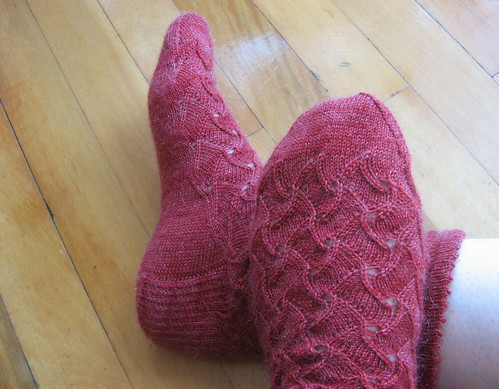
Scroll Lace Socks done and modeled
(Additional photos of the socks can be found in previous posts, or by clicking here.)


Scroll Lace Socks

materials
100 grams of a thin fingering weight yarn, set of five 1.75mm (US size 00) doublepointed needles, yarn needle for grafting and finishing

gauge (in stockinette in the round)
11 stitches per inch (44 stitches per 4 inches / 10 centimeters)

Note On Sizing, Fit, and Gauge (read this!): I have relatively small feet and relatively skinny ankles. The stitch pattern I used in this sock does not have a lot of give to it. These socks fit me perfectly, but I do have to tug to get them on. Many (heck, most) of you have knit Jaywalkers -- it's the same kind of deal. My recommendation is that if you have ever had trouble with any socks ever being difficult (or impossible) to get over your heel, go up one needle size for the leg of this sock. If you have started them and are unsure about whether you'll be able to get them on, put them on scrap yarn and try them on now. If you have large, or maybe even medium sized ankles and feet, consider dropping to 9 or 10 stitches per inch for the entire sock. I think these are great socks, but they can only be great if you can wear them. Knit with these sizing and gauge issues in mind, please!

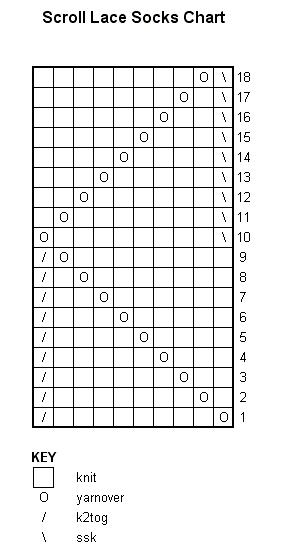
chart
Scroll Lace Socks chart
(Click here for a downloadable version of the chart.)

casting on and hem
Loosely cast on 80 stitches (20 per needle). I prefer the Twisted German Cast On, but your preferred stretchy sock cast on will do.

Work 8 rounds of plain stockinette (knit every stitch)

Next round create the picot edge by work [yo, k2tog] around

Work 8 rounds of plain stockinette

On the next round knit the cast on edge together with your live stitches. I do this by taking a loop from the cast on edge, placing it on the left needle, and knitting it with the next live stitch on the needle as if I were doing a k2tog. Simply proceed around the cast on edge, picking up a loop from the next cast on stitch each time.

Work 2 rounds of plain stockinette

Note: If you are knitting the leg on larger needles, but are worried about droop, consider enclosing a band of elastic inside the picot hem. I've never actually tried this, but I bet it would help with droopiness.

leg
Work the chart (18 row repeat) 5 times, or to length desired. Each row of the chart will be repeated 8 times around the circumference of the sock leg.

heel flap
After completing the desired number of leg repeats, turn the sock, slip 1, and purl 39. There will now be 40 pattern stitches being held on 2 needles, and 40 heel flap stitches on one needle.

Turn, [slip 1, knit 1] across the heel flap

Repeat the above two rows (1. slip 1, purl 39; 2. [slip 1, knit 1] across) 22 more times, for a total of 23 repeats of the heel pattern (46 rows total)

heel turn
Slip 1, purl 22, p2tog, purl 1, turn
slip 1, knit 7, ssk, k1, turn

Continue in pattern, always decreasing (p2tog or ssk) across the gap and working one plain stitch (purl or knit) after the decrease, so that you incorporate 2 more stitches into the heel cup with each short row worked. You will end on a knit row, and should have 24 stitches on the needle.

gusset
Continuing in a clockwise manner, pick up 25 stitches along one side of the gusset -- one stitch per every 2 rows of the heel flap, plus 2 extras before the instep, to avoid holes. This will be needle 1

Work across the instep in the chart pattern, starting on row 1. There will be 4 repeats of the chart pattern across every row of instep. These needles will be needles 2 and 3.

Pick up 25 stitches for the other side of the gusset. This will be needle 4.

Knit across the heel flap, and arrange the stitches so that half (12) are on needle 4 and half are on needle 1.

On the next round, knit across needle 1, twisting the gusset stitches as you knit them (this is done by knitting through the back loop, if you knit the traditional way), continue the instep pattern on needles 2 and 3 with row 2 of the chart, knit across needle 4, twisting the second half of the gusset stitches as you knit them.

(On all following rounds, the gusset and heel/sole stitches on needles 1 and 4 will all be knit plain, and all of the instep stitches on needles 2 and 3 will be knit according to the chart, as you have been doing.)

On the next round, start the gusset decreases. Knit to 3 stitches from the end of needle 1, k2tog, k1, work the instep stitches across needles 2 and 3, k1, ssk, and knit to the end of the needle 4.

Work the next round "plain" - stockinette with no decreases for the gusset stitches (needles 1 and 4), and the next round of the chart as written for the instep stitches (needles 2 and 3).

Alternate decrease and "plain" rounds until there are 20 stitches on needle 4 and 20 stitches on needle 1, for a total of 80 stitches around all 4 needles.

foot
Continue work in pattern until the sock is about 2" shorter than your foot. For me that was 5 pattern repeats. My feet are slightly smaller than average, so you may need more repeats than that. Try to end on a full or half repeat -- on row 9 or 18 of the chart pattern.

toe
Knit one round (including the instep stitches) in stockinette.

Work one decrease round: Knit to the last three stitches on needle 1, k2tog, knit 1; start needle 2 with knit 1, ssk, knit to the end of needle 2; knit to the last three stitches on needle 3, k2tog, knit 1, start needle 4 with knit 1, ssk, knit to the end of needle 4 (round completed)

Work one plain stockinette round (all knit)

Alternate decrease and plain stockinette rounds 6 times more (7 times total), until there are 13 stitches left on each needle.

Work the decrease round 7 times more, with no intervening plain stockinette rounds, until there are 6 stitches left on each needle.

Knit the stitches from needle 1 onto needle 4. Slip the stitches from needle 3 onto needle 2.

Cut the working yarn, and graft the toe closed with kitchener stitch.

finishing
Weave in ends and block as desired.


The original line by line instructions for this stitch pattern can be found in Barbara Walker's 2nd Treasury. Please let me know if you catch any errors or typos in the pattern. Happy Knitting!

Next time: Tales from sock designing? Teaser photos? More handspun? Colorwork bag swatches? I honestly don't know. Any requests?

Labels: , ,

Thursday, March 29, 2007

objects of great promise

It was a great idea, then a troublesome idea, then a disappointingly bland idea. As I was knitting, I was quite unsure of it. One of those projects where the idea that you thought was brilliant might end up being a more complicated and less attractive variation on something that didn't need to be tinkered with. One of those projects where, in the midst of it, you're sure you'd be better off cutting it off the needles and throwing it to a pack of feral dogs. In the end, I'm fairly pleased at the results. No dogs involved. (I'm quickly learning this is the greatest mental pitfall in designing. Doubting oneself too much right before or right after doubting oneself too little. How does one learn to doubt themself just the right amount?)

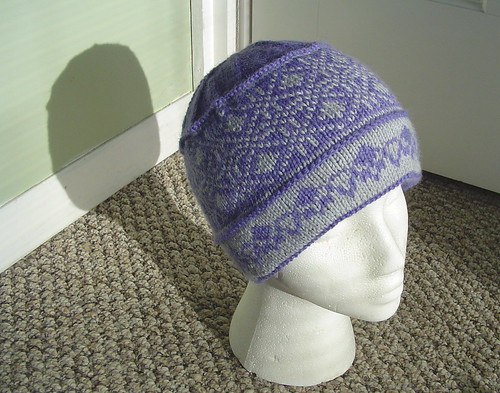
faux brim hat


The construction is my own design, and the colorwork charts are adapted from Latvian Dreams. I used leftover worsted weight wools -- Elann Peruvian Highland Wool in purple, and Naturally Merino et Soie in grey.

I was originally inspired to design and knit a colorwork hat with a fold-up brim by a hat I've seen a woman wearing around Keene. (Do you ever find yourself with an urge to go up to someone and ask to examine their clothing? It's so hard to resist, but I want to avoid being known as the town knitting crazy, so I exercise a bit of willpower and leave people alone.) I'm fairly certain that the hat I was admiring is double knit, as the brim pattern is a negative of the pattern on the rest of the hat. It's also obviously machine knit at a very tight gauge, and I knew there was no way I was going to recreate it with the materials I had at hand.

I realized fairly early on that a fold-up colorwork brim wouldn't be easy to execute well. I was concerned with curling, as well as with a way to finish off the top edge of the brim in a neat and tidy manner. I considered an icord edge, but finally decided that it might be interesting to design a hat that looks like it has a colorwork brim, but doesn't really have one. I provisionally cast on the stitches for the hat, knit the brim pattern, and then knit a purl row before moving on to the patterning for the rest of the hat. I hoped this would give the illusion of the edge of a brim, but was unsure of whether the effect would work until the hat was done.

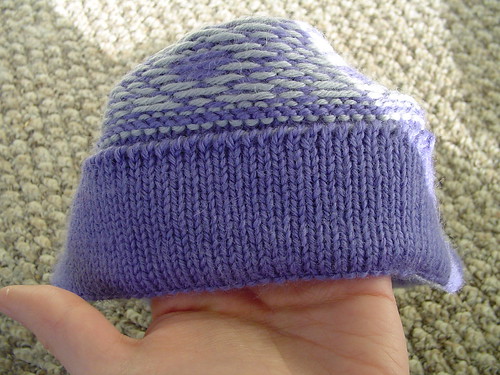
The rest of the hat construction is pretty basic. There is a turned hem, which I knit after the rest of the hat was completed, picking up stitches from the provisional cast on. I knit it in that order because I was frankly not sure how deep the faux brim would be, and wanted the turned hem to attach to the body of the hat where the faux brim ended. That way it added some extra bulk to where the faux brim was, as well as lining up well with some plain (non-colorwork) stitches at the brim transition, which made tacking down the hem a lot easier than it would have been in the midst of floats. Best of all, I didn't have to bind off any stitches. I simply used whip stitch to attach the live stitches at the end of the hem to a row of purl bumps on the inside of the hat. Super simple, and super stretchy. Take a peek:

faux brim hat hem, from the inside


I don't have a pattern written up for this hat. I eventually want to do it again, but perhaps in a tighter gauge (with sport or fingering weight yarn), and with different colorwork charts. I'm not completely satisfied with the charts I chose for the hat, and would prefer to use something I've designed on my own if I'm going to write up a pattern. Look for it in many months. Many, many months. (Oh, and if you're wondering, there will still be a pattern for that orange and white wavy hat. I've just been dealing with some logistical issues and decisions, which have delayed me. But it's coming. Eventually. Sooner than in many months, if that helps.)


Finishing that hat felt good, but not nearly as good as knitting these:

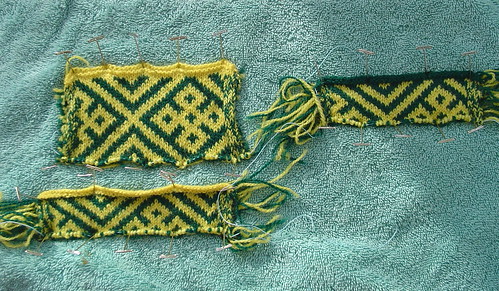
AC Cardigan swatches


Swatches for my Autumn Color Cardigan! The largest one, in the top left, is the winner. I started out with 2.75mm needles (bottom left swatch), which were just way too small. The 3mm needles were too small, also, so I channeled my inner Goldilocks and made things work out on the third try. 3.25mm needles it is. I'm going to have to block a bit for length, most likely, but not too much. I was having a lot of trouble getting anywhere near the row gauge I needed (8.5 rows per inch), but got pretty close with the 3.25mm needles, and don't want to go any larger, as that will be very bad for my stitch gauge. All in all, I'm satisfied. I won't have to redesign the sweater or block it to death to get something the right size.

I really love the fabric I got on the 2.75mm needles. I think that's what I'd be likely to use if I were designing my own sweater from scratch. In case you're wondering why the losing swatches are so small, it's because they're not done. They don't need to be done because it was pretty obvious from initial measurements that they weren't going to work. But one of the great things about the method I use for knitting fair isle swatches is that they never need to be done. I always knit on the right side, breaking the yarn at the end of the row, shifting the knitting back to the other end of the circular needles, and starting again for the next row. You can always add more rows to your swatch later, if you put it on scrap yarn instead of binding off. I don't purl back in fair isle sweaters, so I definitely don't want to purl back in my swatches. I know that there's an option to leave loops of yarn across the back, instead of breaking them off, but I don't like that method. With my method, I can tie the yarn ends together to keep the edges nice and tight. I also find that the looping method creates a lot of confusion and potential tangles for me, and don't think it would be as easy to block as the method I use. It means you need to be willing to sacrifice some yarn, but I also think it's worth keeping a couple of extra balls of yarn around just for this purpose.
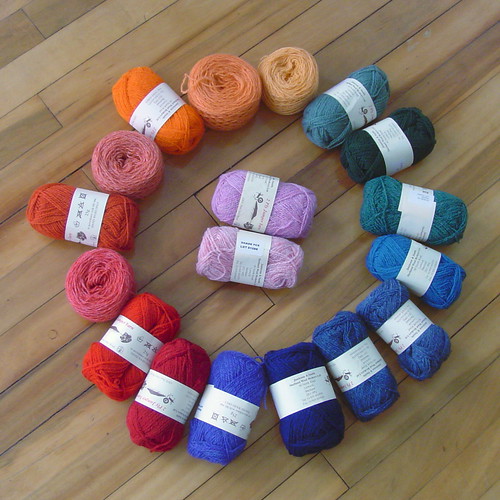
By the way, those aren't the colors of the sweater. I just used some J&S I have sitting around for swatching purposes. The real sweater will be a lot more colorful:

Autumn Color Cardigan yarn

Labels: , , ,

Monday, March 12, 2007

crab legs

Crustacean socks modeled


Crustacean Socks (using a stitch pattern from Sensational Knitted Socks) in Dale Baby Ull, knit on size 1 needles. I'm still completely enraptured by these socks, and by the stitch pattern. It's easier than it may look (I had it memorized before I finished the first pattern repeat), stretchy, and full of interesting texture. It's based on 5x3 ribbing, though as you can see, I opted to do a 2x1x2x3 ribbing at the top. I really like how that flows into the stitch pattern, and think it's probably clingier than 5x3 ribbing would be.

Speaking of crustaceans and crabs, you should listen to the latest episode of Quirks and Quarks (a wonderful CBC science show, also available as a podcast). There is a segment about how early humans got crabs from gorillas. Okay, different kind of crabs (I don't think lice are actually crustaceans), and Australopithecus, not Homo, and certainly not Homo Sapiens. But still, it's a pretty cool story that I happened to hear as I was knitting the socks. I couldn't help but share the crabs humor. Be a science geek with me! (It really is an interesting story, and not as gross as it sounds.)

In non-parasitic news, I just placed my order for yarn for the Autumn Color Cardigan. This involved placing a phone call to Scotland. If it weren't so expensive (and so confusing to figure out how to dial internationally), I'd want to randomly call people in the UK every day. Oh the accents! It also felt pretty special to be ordering Shetland yarn from someone on the island of Shetland. If I can't buy it locally, buying it from its actual local source, from someone with an accent like butter, is a good consolation. I can't wait to get started on this sweater. Let's see if I can hold out until April...

Labels: ,

Monday, March 05, 2007

waves of color

Wavy Hat


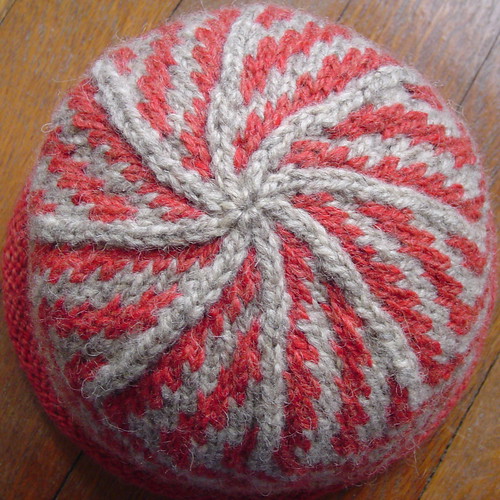
I finally got around to washing and photographing the wavy hat, which I think I finished knitting about 2 weeks ago. It was just a fun little project with worsted leftovers, designed as I went along, with no attention paid to gauge. The yarn is Harrisville Highland (you might recognize the orange from my braid and bobbles hat), and the colorwork is based on a chart from Sensational Knitted Socks. (Pattern 2, on page 82, if you're really curious.) I cast on 96 stitches on size 6 16" circs, knit several plain rows for the roll brim, and then followed the chart until the hat was a good height. The chart is ridiculously easy, alternating 2 stitches of each color around and around. All that creates the wave effect is shifting the starting point on some of the rows. This, and many of the other basic colorwork charts in the book, would be a great starting point for anybody who has wanted to try stranded colorwork, and is looking for something easy as a first project.

The top of the hat took some tinkering:

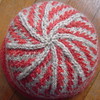
Wavy Hat top


I wanted to do my standard 8 decrease swirl, and played around with a bunch of options before settling on a way to work the colorwork with the decreases. You can probably tell that I abandoned the wave chart for the top, in favor of keeping the color shifts in one direction. I think it worked out fairly well.

The hat will join my very tiny pile of garments for the Dulaan project, which is why I was able to completely ignore gauge. This hat will fit someone, and getting any specific size didn't really matter. I have a couple of interesting ideas for more colorwork hats, using up some more of my leftover worsted weight yarn. For these, I'm probably going to use charts in Joyce Williams' spectacular book Latvian Dreams. I have an urge to gush over the book in this post, but it would be disorganized gushing. I have plans to do a proper review of the book at some point, so I'll try to refrain from too much gushing right now. Needless to say, the book is spectacular, as a pattern book, a reference book, and as a collection of charts. I'm frankly overwhelmed at the choices for colorwork charts, and must sit down and force myself to choose just one or two to play with, or else I'll never get anything done.
Remember when I said, at the beginning of the year, that it might be a while before I do colorwork again? I guess I was wrong. I'm really excited by my hat design ideas, and have decided that my next sweater will be colorwork, too. I was wearing Vertical Stripes the other day, and realized that I really wanted to knit another one. Not another of the same sweater, but another fingering weight fair isle sweater with all-over patterning. I want to knit the Autumn Color Cardigan, which graces the cover of Sweaters From Camp. That sweater is the reason I bought the book in the first place, and it's long overdue that I actually get around to knitting it. I have some yarn money squirreled away, from earnings from my Stitch 'n Bitch calendar pattern, and from some commissioned knitting projects I've recently completed. It should be just about enough to pay for this project, though I'll have to kick in some extra to cover the expense of shipping from the UK. I had been planning to knit Am Kamin this spring, but the pull of fair isle is too great. I'm very excited. It will be my first time knitting set-in sleeves knit in the round and saddle shoulders, as well as my first colorwork project in which both the background and foreground colors are constantly shifting. A challenge, a learning experience, and the most gorgeous sweater I may ever knit.

Labels: , ,