Saluting NaNoWriMo in length, if not in content
I used to find spinning content on blogs boring. It all looked the same to me, I didn't care about it, and I skipped reading blog posts about making yarn in favor of reading blog posts about making things from yarn. And so I must apologize to those of you who read (or used to read) this blog, and are similarly frustrated and bored when I talk about making yarn. While I still love knitting, right now it's spinning that completely captivates me.
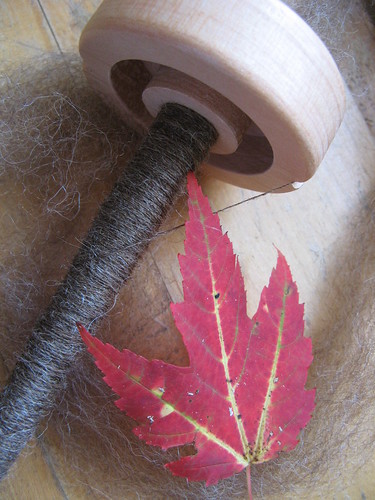
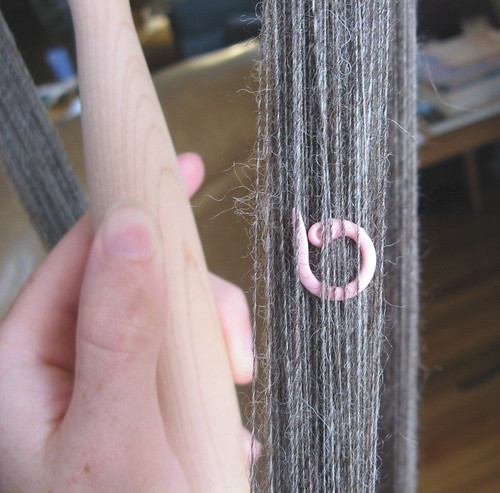
I learned how to Navajo ply (or chain ply) last weekend. It was a lot easier than I thought it would be, using a sort of "park and ply" technique. My method was to let the spindle hang, doing whatever it pleased, while I chained up about an arm span's length. I pinched off the top loop with my left hand (so twist wouldn't later enter it), grabbed my chains about halfway down with the same hand, and then used my right hand to roll-start the spin. I let the twist build up in that bottom half of the chained singles, then released the top half (still pinching off that top loop), to let the twist enter the rest of the length. When it was enough twist I'd stop the spindle, wind the plied yarn on, and start again with that loop I pinched off at the top. I don't think the process was much slower than what I could reasonably do on a drop spindle without "parking", because twist builds up so quickly that I'd have to stop my spindle to wind the yarn on quite often, anyway. I can't wait until I have a wheel and can ply more smoothly and continuously, though. I found Navajo plying to be a quite soothing process once I got the hang of it. There were frustrating moments, like when I'd start the spin at such a great speed and angle that the spindle would fly across the room, leaving a mess of tangles in its wake.
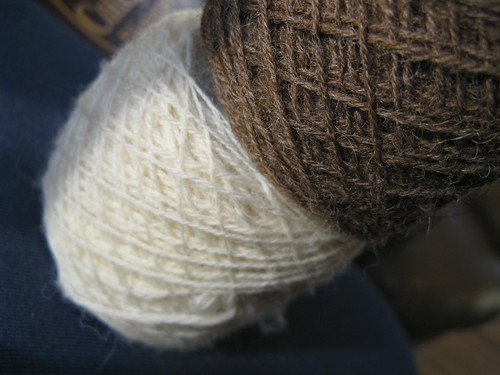
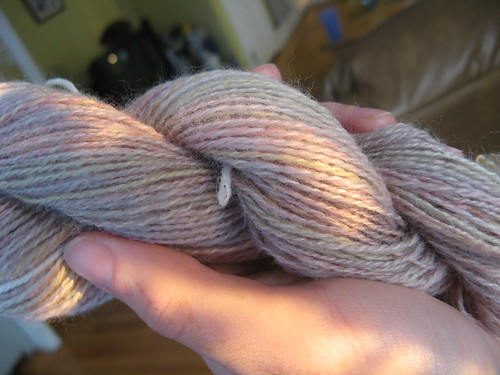
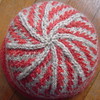
The photo above is of two of the four colors of the Shetland sampler, after being plied and set. My camera batteries and natural light both ran out before I could properly photograph the other two colors. These two colors and the light brown are all about a fingering weight, though I admit that I haven't done a WPI count, yet. The grey, which I spun first, seems to be more of a sport weight.
I was concerned about the yarn after I plied it and before I set it because it seemed stringy. There was hardly any bounce to it. But after a good simmer on the stove, the yarn really came to life. It's quite elastic now, and I'm very proud of it. It feels like when I first became confident in my stranded colorwork abilities -- when that lightbulb came on, and I realized that I had the tools to knit all the Starmore sweaters my heart could desire. After all that concern about having spent dozens upon dozens of hours spinning a stringy, lifeless yarn, the joy of seeing what bounce and spring the setting process gave it has left me with a feeling of confidence and fibrous power. I can SPIN! I can make things I want to knit with!
Unfortunately, I don't think I have enough to knit the colorwork hat that I'd planned, so I may send the yarn itself to the friend for whom I was hoping to knit the hat, so she has a chance to crochet with some woolly handspun. I do think I'll keep the thicker grey for myself, to incorporate in what I'm already calling the "Scrapple" bag. Alex and I have been using my Coronet hat as a Scrabble bag, and that just won't do. Little bits of handspun, though, have great potential to remedy this situation.
I also Navajo plied some of the Spunky Eclectic BFL last weekend:
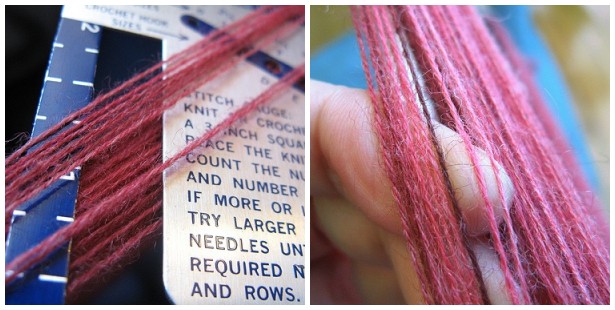
That's about .75 oz, which means I have about 3.25 oz to go. I've ordered a lighter drop spindle, so hopefully I'll be able to comfortably spin more than .75 oz at a time, soon. It's taking a bit longer than I anticipated to get that spindle, so I've had to put the BFL project on hold. It's a bit frustrating because I hardly want to do anything right now more than I want to spin. But of all life's potential hardships, I can hardly complain about this. I think the yarn in the above pic is about a laceweight, though I haven't set it yet, so don't know if it will plump up. Right now the plan is to spin and ply all of it to match this first bit, and then use it for a shawl.
There's been other spinning activity going on in my house, but I'll save that for another post. Instead, here are some socks, for all of you who couldn't care less about the spinning.
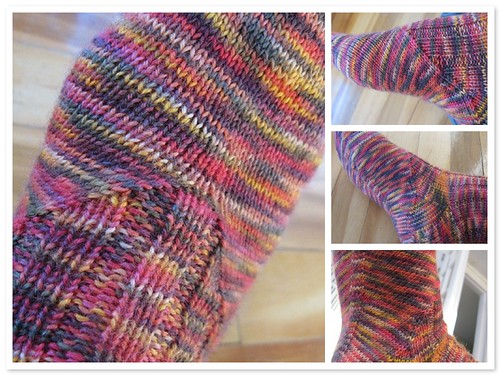
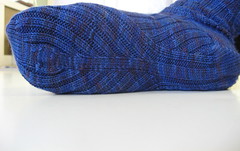
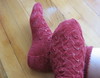
This is the Arch-Shaped Sock by Jen Showalter. I used Mama E's C*eye*ber Fiber sock yarn in the colorway Purgatory Orphan, which may not exist anymore. (It was one of the colorways she made when trying to perfect the colorways for Brenda Dayne's Brother Amos socks. I love the name!) I adore the way the socks fit, and am so happy I knit this pattern. I did find that there were some vagaries and mistakes in the pattern itself, but nothing really major if you've knit socks before and have the confidence to rework some minor elements. I do plan to use this shaping in the future, perhaps for a design idea I have, and do plan to alter it so it works a bit more elegantly with the gusset decreases. But I'd definitely recommend that anyone with decent arches knit a pair of these for themself. They really do hug your feet.
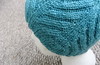
You can probably tell that I altered the pattern a bit, to continue the ribbing down the front of the foot. I've been doing a lot of ribbing lately, including a hat design that is based on the same idea I want to use for the sock design I mentioned above. Here is a sneak peek at one of the hats:
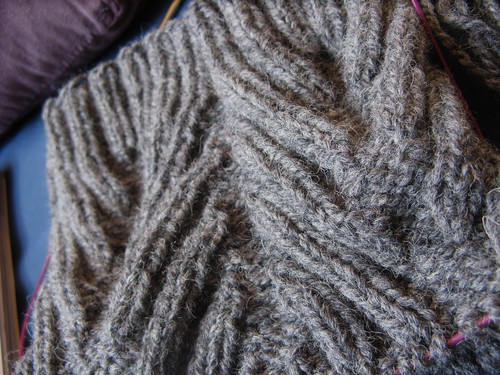
More on that later, when the pattern is written. (Don't worry, I'm self publishing this one, so there won't be any of that annoying months- or year-long teasing about something you can't see!)
I really should have posted some time last week, eh? If you're still reading, I have a book review for you. It's a book you've surely seen reviewed in many other places, but I am so delighted with the book that I feel like I need to add in my "me too." The book is The Knitter's Book of Yarn by Clara Parkes. I should say that I received this book free, from the publisher, as a review copy. I don't feel that that alters my opinion of the book at all, but as a former social science researcher feel a moral obligation to disclose the fact that this book was essentially a gift from the people trying to sell it.
This book is what has been missing from the fiber arts shelves of the bookstore. There are hundreds (or at least dozens) of beautiful, informative, inspiring books on the market about techniques and patterns, but this is the first book I've seen that focuses on yarn, itself. I feel that I know a lot about yarn, as a compulsive researcher (I have been known to check Consumer Reports before buying a simple toaster), and as someone who has been knitting for years and intensely immersing herself in spinning for the past few months. It turns out that I did know a lot, and still learned a lot more from this book. The writing is clear and engaging, the format is easy to follow, and the patterns are clever and interesting. Organizing the patterns by yarn ply is something I've never seen before, and really opened my eyes to mistakes I've made and details I've overlooked in the past about my own yarn choices for projects.
If I could change anything about the book, I'd split it into two volumes. I think that the chapters on fiber type and making yarn, plus an introduction to the characteristics of ply type, could be a book on its own. As much information as this book contains, I want more! I wish all 250 pages were devoted to that exposition, with a companion volume for the patterns, with expanded photographs.
But if my biggest complaint is "I want MORE!," I suppose things aren't all that bad. I'm fairly picky about what books I'll actually buy, and this is a book I know I would have eventually paid money for if I hadn't been lucky enough to receive a copy for free. If you're interested in expanding your knowledge about yarns, and interested in becoming better at matching yarns to patterns (or patterns to yarns), flip through this book, buy it, or at least request that your local library acquire a copy. It's an excellent resource that will not be redundant with anything already on your bookshelf.
I learned how to Navajo ply (or chain ply) last weekend. It was a lot easier than I thought it would be, using a sort of "park and ply" technique. My method was to let the spindle hang, doing whatever it pleased, while I chained up about an arm span's length. I pinched off the top loop with my left hand (so twist wouldn't later enter it), grabbed my chains about halfway down with the same hand, and then used my right hand to roll-start the spin. I let the twist build up in that bottom half of the chained singles, then released the top half (still pinching off that top loop), to let the twist enter the rest of the length. When it was enough twist I'd stop the spindle, wind the plied yarn on, and start again with that loop I pinched off at the top. I don't think the process was much slower than what I could reasonably do on a drop spindle without "parking", because twist builds up so quickly that I'd have to stop my spindle to wind the yarn on quite often, anyway. I can't wait until I have a wheel and can ply more smoothly and continuously, though. I found Navajo plying to be a quite soothing process once I got the hang of it. There were frustrating moments, like when I'd start the spin at such a great speed and angle that the spindle would fly across the room, leaving a mess of tangles in its wake.
The photo above is of two of the four colors of the Shetland sampler, after being plied and set. My camera batteries and natural light both ran out before I could properly photograph the other two colors. These two colors and the light brown are all about a fingering weight, though I admit that I haven't done a WPI count, yet. The grey, which I spun first, seems to be more of a sport weight.
I was concerned about the yarn after I plied it and before I set it because it seemed stringy. There was hardly any bounce to it. But after a good simmer on the stove, the yarn really came to life. It's quite elastic now, and I'm very proud of it. It feels like when I first became confident in my stranded colorwork abilities -- when that lightbulb came on, and I realized that I had the tools to knit all the Starmore sweaters my heart could desire. After all that concern about having spent dozens upon dozens of hours spinning a stringy, lifeless yarn, the joy of seeing what bounce and spring the setting process gave it has left me with a feeling of confidence and fibrous power. I can SPIN! I can make things I want to knit with!
Unfortunately, I don't think I have enough to knit the colorwork hat that I'd planned, so I may send the yarn itself to the friend for whom I was hoping to knit the hat, so she has a chance to crochet with some woolly handspun. I do think I'll keep the thicker grey for myself, to incorporate in what I'm already calling the "Scrapple" bag. Alex and I have been using my Coronet hat as a Scrabble bag, and that just won't do. Little bits of handspun, though, have great potential to remedy this situation.
I also Navajo plied some of the Spunky Eclectic BFL last weekend:
That's about .75 oz, which means I have about 3.25 oz to go. I've ordered a lighter drop spindle, so hopefully I'll be able to comfortably spin more than .75 oz at a time, soon. It's taking a bit longer than I anticipated to get that spindle, so I've had to put the BFL project on hold. It's a bit frustrating because I hardly want to do anything right now more than I want to spin. But of all life's potential hardships, I can hardly complain about this. I think the yarn in the above pic is about a laceweight, though I haven't set it yet, so don't know if it will plump up. Right now the plan is to spin and ply all of it to match this first bit, and then use it for a shawl.
There's been other spinning activity going on in my house, but I'll save that for another post. Instead, here are some socks, for all of you who couldn't care less about the spinning.
This is the Arch-Shaped Sock by Jen Showalter. I used Mama E's C*eye*ber Fiber sock yarn in the colorway Purgatory Orphan, which may not exist anymore. (It was one of the colorways she made when trying to perfect the colorways for Brenda Dayne's Brother Amos socks. I love the name!) I adore the way the socks fit, and am so happy I knit this pattern. I did find that there were some vagaries and mistakes in the pattern itself, but nothing really major if you've knit socks before and have the confidence to rework some minor elements. I do plan to use this shaping in the future, perhaps for a design idea I have, and do plan to alter it so it works a bit more elegantly with the gusset decreases. But I'd definitely recommend that anyone with decent arches knit a pair of these for themself. They really do hug your feet.
You can probably tell that I altered the pattern a bit, to continue the ribbing down the front of the foot. I've been doing a lot of ribbing lately, including a hat design that is based on the same idea I want to use for the sock design I mentioned above. Here is a sneak peek at one of the hats:
More on that later, when the pattern is written. (Don't worry, I'm self publishing this one, so there won't be any of that annoying months- or year-long teasing about something you can't see!)
I really should have posted some time last week, eh? If you're still reading, I have a book review for you. It's a book you've surely seen reviewed in many other places, but I am so delighted with the book that I feel like I need to add in my "me too." The book is The Knitter's Book of Yarn by Clara Parkes. I should say that I received this book free, from the publisher, as a review copy. I don't feel that that alters my opinion of the book at all, but as a former social science researcher feel a moral obligation to disclose the fact that this book was essentially a gift from the people trying to sell it.
This book is what has been missing from the fiber arts shelves of the bookstore. There are hundreds (or at least dozens) of beautiful, informative, inspiring books on the market about techniques and patterns, but this is the first book I've seen that focuses on yarn, itself. I feel that I know a lot about yarn, as a compulsive researcher (I have been known to check Consumer Reports before buying a simple toaster), and as someone who has been knitting for years and intensely immersing herself in spinning for the past few months. It turns out that I did know a lot, and still learned a lot more from this book. The writing is clear and engaging, the format is easy to follow, and the patterns are clever and interesting. Organizing the patterns by yarn ply is something I've never seen before, and really opened my eyes to mistakes I've made and details I've overlooked in the past about my own yarn choices for projects.
If I could change anything about the book, I'd split it into two volumes. I think that the chapters on fiber type and making yarn, plus an introduction to the characteristics of ply type, could be a book on its own. As much information as this book contains, I want more! I wish all 250 pages were devoted to that exposition, with a companion volume for the patterns, with expanded photographs.
But if my biggest complaint is "I want MORE!," I suppose things aren't all that bad. I'm fairly picky about what books I'll actually buy, and this is a book I know I would have eventually paid money for if I hadn't been lucky enough to receive a copy for free. If you're interested in expanding your knowledge about yarns, and interested in becoming better at matching yarns to patterns (or patterns to yarns), flip through this book, buy it, or at least request that your local library acquire a copy. It's an excellent resource that will not be redundant with anything already on your bookshelf.
Labels: designing, hat, productreview, socks, spinning
posted by Rebekkah at 1:18 PM
8 comments